AI-native concept · self-initiated
crux
An AI executive decision-intelligence tool. Scattered signals become a structured decision brief: options laid out, evidence attached, an AI recommendation with its reasoning and confidence, and the human firmly as the one who makes the call. I designed it end-to-end around one problem: a recommendation an executive can't defend is one they won't make.
A decision tool that turns scattered signals into a clear, defensible call.
TL;DR · Concept Summary
Executives make high-stakes calls on fragmented information. A dashboard here, a deck there, a gut feel, a hallway conversation. Then they have to defend those calls to a board, a team, or themselves. Crux is a self-initiated concept that structures a decision. It gathers the relevant signals, lays out the options, and offers an AI recommendation with explicit reasoning and a confidence level, while keeping the executive unambiguously the decision-maker. I ran the full process: interviews with decision-makers, an audit of how executive decisions actually get made, IA built from the anatomy of a decision, three core flows, then polished hi-fi screens. Defensibility and reasoning-transparency were the load-bearing design problem throughout.
Concept · self-initiated · not client work
Type
AI-native product concept
Role
Sr. UX Lead (end-to-end)
Timeline
Self-initiated · 2026
Platform
Responsive web, desktop-first
Tools
Figma, decision modelling, exec interviews
process
Crux is a self-initiated concept, not a client engagement. I chose executive decision-making because it's the highest-stakes, lowest-tooled workflow in any company. The decisions that matter most are made with the least structure. It's also the sharpest possible test of AI-trust design. The bar for an AI that influences a CEO's call is extraordinarily high. It has to be transparent, defensible, and humble about its own confidence, or it's worse than useless. Designing for that bar is the whole point.
A consequential decision is rarely a data problem. The signals usually exist somewhere. It's a synthesis-and-defensibility problem: pulling scattered evidence into a coherent picture, weighing options honestly, and being able to explain afterwards why this call and not another. The interesting design challenge isn't 'let AI decide'. It's designing an AI that makes a leader's reasoning sharper and more defensible while leaving the decision firmly theirs.
Why this concept
Three reasons. It's the highest-stakes workflow with the least purpose-built tooling. Reasoning-transparency and defensibility are the hardest, most important AI-trust problems there are. And it lets the case study show a third distinct process, decision-led and high-stakes, alongside ethnographic Slate and systems-led Almanac.
Meet the people who have to make the call.
A consequential decision has a person who owns it, a person who prepares it, and a room that has to live with it. The executive carries the accountability. The chief of staff assembles the picture. The exec team needs to understand and trust the reasoning. Crux has to make the call sharper for the owner without taking the call away from them.
Elena Vasquez
Executive · primary
A VP or C-level leader making several consequential calls a quarter (pricing, hiring freezes, market entry, big bets), each on incomplete information and under scrutiny.
goals
- Make a sharper call faster, without waiting weeks for a perfect deck
- Be able to defend the decision with clear reasoning, not just instinct
- Stress-test her own thinking against an honest second opinion
frustrations
- The signals exist but are scattered across dashboards, decks, and people
- By the time a full analysis is ready, the decision window has half-closed
- Hard to separate a well-reasoned recommendation from a confident-sounding one
jobs to be done
“When I face a consequential call, I want the signals and options structured with honest reasoning, so I can decide fast and defend it.”
BI dashboards, decks, her exec team, gut
Tom Akintola
Chief of Staff
The person who turns a vague 'should we do X?' into a decision the executive can actually make, by chasing data, building the deck, and pre-wiring the room.
goals
- Assemble a complete, balanced picture without a week of manual work
- Surface the real trade-offs, not a deck that argues one side
- Give the exec something defensible to take to the board
frustrations
- Days lost stitching signals from a dozen sources into one view
- Pressure to build a deck that supports a predetermined answer
- No structured way to capture why a decision was ultimately made
jobs to be done
“When I prep a decision, I want the evidence and options assembled and balanced, so the exec gets the real trade-offs, fast.”
Spreadsheets, BI tools, decks, calendar
Priya Nair
Exec Team Member
A peer or report in the room when the decision lands. Needs to understand the reasoning well enough to commit to it and carry it out.
goals
- Understand why this call was made, not just what was decided
- Trust that options were weighed honestly, not cherry-picked
- Be able to align and commit, even on a call she'd have made differently
frustrations
- Decisions arrive as conclusions with the reasoning left out
- No visibility into what alternatives were considered and dropped
- Hard to commit to a call she can't see the logic behind
jobs to be done
“When a decision is made, I want to see the reasoning and the options weighed, so I can align and commit with confidence.”
Email, decks, the meeting
in their words
“The data exists. Pulling it into a decision is the hard part.”
“By the time the analysis is ready, the moment's gone.”
“I can't tell a good recommendation from a confident one.”
“Three days building the deck, ten minutes making the call.”
“I need to defend this to the board on Monday.”
I sat in on how the call actually gets made.
Decision-maker interviews
Rather than ask executives what a good decision looks like in theory, I reconstructed real ones: what the call was, what information they had, what they wished they'd had, how they weighed it, and how they later defended it. Five in-depth interviews with decision-makers and chiefs of staff, walking back through recent consequential calls from trigger to defence.
Participants
5 decision-makers
Method
Decision reconstruction interviews
Traced
Real calls, trigger to defence
Captured
Signals, weighing, time pressure, defence
The anatomy of a decision
Walking back through one real decision showed where the friction and the risk concentrate, and why so much of the effort goes into assembling the picture rather than actually reasoning about it.
- Step 1Trigger
A consequential question lands: 'do we enter this market this quarter?'
- Step 2Signal huntpain point
Chief of staff spends days pulling numbers from BI, decks, and a dozen people.
- Step 3Deck assemblypain point
Findings packed into a deck that, under pressure, quietly tilts toward one answer.
- Step 4The room
Exec team debates for an hour; the loudest voice and the latest data point carry weight.
- Step 5The callpain point
The executive decides, often on instinct the deck only partly informed.
- Step 6The defencepain point
Weeks later, has to justify the call to the board with reasoning that was never captured.
What the interviews clustered into
Observations across all five interviews affinity-mapped into four themes. Each is a place where consequential decisions lose rigour, speed, or defensibility.
Assembly eats the time
Most of the effort goes into gathering and formatting signals, not reasoning about them. The picture takes days; the decision takes minutes.
Decks argue, they don't weigh
Under pressure, decision materials tilt toward a predetermined answer. Honest trade-offs get smoothed away in service of a recommendation.
Confidence masquerades as quality
Leaders can't easily separate a well-reasoned recommendation from a confidently-delivered one. Conviction is mistaken for rigour.
Reasoning isn't captured
The why behind a call evaporates the moment it's made, leaving nothing to defend it with, or to learn from later.
Three insights that drove the design
The deliverable is a defensible call, not a dashboard
Executives don't need more data surfaced. They need it structured into options, evidence, and reasoning they can stand behind. A dashboard informs; a decision brief decides.
→ Structure the decision, not the data (Principle 1)
Honesty beats persuasion
The system's value is in laying out trade-offs straight, including the case against its own recommendation. An AI that argues one side is just a faster biased deck.
→ Show the case against (Principle 2)
The reasoning is the product
A recommendation is worthless without its reasoning and confidence exposed. Defensibility comes from traceable logic, not a confident verdict.
→ Reasoning + confidence, always (Principle 3)
★ key insight
Executives don't want the machine to make the decision. They want it to structure the decision (options, evidence, honest reasoning, and a confidence level) so the call they make is faster, sharper, and defensible.
How executive decisions actually get tooled.
The decision sprawl
I mapped everything a leader leans on to make a consequential call. The problem is that none of it is built for deciding: each tool answers a slice, none assembles the whole, and the synthesis happens in a human's head under deadline.
Nothing structures the decision. A dozen tools surface slices, and the executive is the synthesis engine, under deadline, with no record of the reasoning.
Heuristic evaluation: the two incumbents
I evaluated the two things executives actually reach for, a BI dashboard (Tableau-style) and a strategy deck, on six heuristics, to locate the systemic gaps a real decision tool would have to close.
Competitive teardown
Six tools across the category, scored on eight capabilities. The pattern: BI tools surface data without structuring a decision; emerging AI tools recommend without showing reasoning. Nothing combines a structured decision brief with transparent reasoning, honest trade-offs, and the human kept in command.
| Capability | Crux | Tableau | Power BI | Strategy deck | Pigment | AI copilots |
|---|---|---|---|---|---|---|
| Structured decision brief | Yes | No | No | Partial | Partial | No |
| Options laid out | Yes | No | No | Partial | Partial | Partial |
| Evidence per option | Yes | Partial | Partial | Partial | Partial | No |
| Reasoning transparency | Yes | No | No | No | No | Partial |
| Confidence signalling | Yes | No | No | No | No | No |
| Case against the rec | Yes | No | No | No | No | No |
| Captures the why | Yes | No | No | Partial | No | No |
| Human in command | Yes | Yes | Yes | Yes | Partial | Partial |
The gap statement
No existing tool structures a decision with transparent reasoning, honest trade-offs, and a confidence signal while keeping the human in command. BI surfaces data, decks persuade, AI copilots over-automate. The defensible, human-led middle is the opportunity.
The hypothesis.
Positioning
Crux is an AI executive decision-intelligence tool. It turns a consequential question into a structured decision brief: options, evidence per option, an AI recommendation with explicit reasoning and a confidence level, including the honest case against, while the executive makes and records the call. It is not a BI dashboard, not a deck tool, and not an autopilot that decides for you.
what it is
- A decision brief: options, evidence, reasoning, confidence
- An honest second opinion that argues both sides
- A record of the call and the why, for defence and learning
what it's not
- Not a BI dashboard that surfaces metrics and stops
- Not a deck tool built to win an argument
- Not an autopilot that makes the decision for you
The decision-centric mental model
The core IA bet: structure the product around the decision, not the data. A leader arrives with a consequential question. The system's job is to frame it as a decision: options, the evidence behind each, a reasoned recommendation with its confidence, and a captured call. Data becomes evidence in service of a decision, not the thing you stare at.
Four design principles
Each principle is a tension resolved in a direction, and each traces directly back to a research insight.
Structure the decision, not the data
Frame everything as a decision (options, evidence, recommendation), never as a wall of metrics. The product's job is synthesis, not surfacing.
From insight: the deliverable is a defensible call.
Always show the case against
Every recommendation carries its own strongest counter-argument and the conditions under which it's wrong. Honesty over persuasion, by construction.
From insight: honesty beats persuasion.
Expose the reasoning and the confidence
No recommendation without its logic and a confidence level, traceable to the evidence. Defensibility comes from transparent reasoning, not a confident verdict.
From insight: the reasoning is the product.
The human makes the call
The AI structures and recommends; the executive decides and the system records it. Command stays unambiguously human, captured, not automated.
From insight: executives want sharper reasoning, not abdication.
How it thinks: architecture & flows.
The decision lifecycle, as tasks
Before any IA, I broke the decision lifecycle into discrete tasks with their dependencies, so the structure would serve the act of deciding, not the display of data.
Card sort: how leaders frame decisions
An open card sort with eight decision-makers tested whether they think in metrics or in decisions. They think in decisions. Participants grouped tasks around 'the call I have to make', not around data sources or dashboards. The sort also settled the top-level surfaces: Decisions, the Brief, Evidence, and a Review log.
Participants
8 decision-makers
Method
Open card sort
Result
Decision-first grouping confirmed
Bonus
Settled the 4 top-level surfaces
Three IA decisions
The brief is the centre
Chose: Made the structured decision brief the core view, with options, evidence, and recommendation in one frame, and a portfolio of decisions above it.
Considered a metrics-dashboard home (rejected, because it's the BI model that leaves synthesis to the human under deadline).
Recommendation and counter side by side
Chose: Rendered the AI recommendation and its strongest counter-argument as adjacent, equal-weight panels, so the case against is impossible to skip.
Considered a recommendation with caveats below (rejected, because caveats get scrolled past; the counter-case has to be structural).
The call is a deliberate, recorded act
Chose: Making the decision is an explicit, gated step that captures the chosen option and the reasoning, a record, not a silent click.
Considered letting the recommendation stand as the decision (rejected, because it blurs the line between AI advice and human command).
Building it.
low-fidelity wireframes
Low-fidelity, greyscale wireframes first, to lock structure and the decision-trust patterns before any colour or brand. The questions at this stage: how do options sit side by side, how does the recommendation share the frame with its counter-argument, and how do confidence and the human-call gate read without drama?
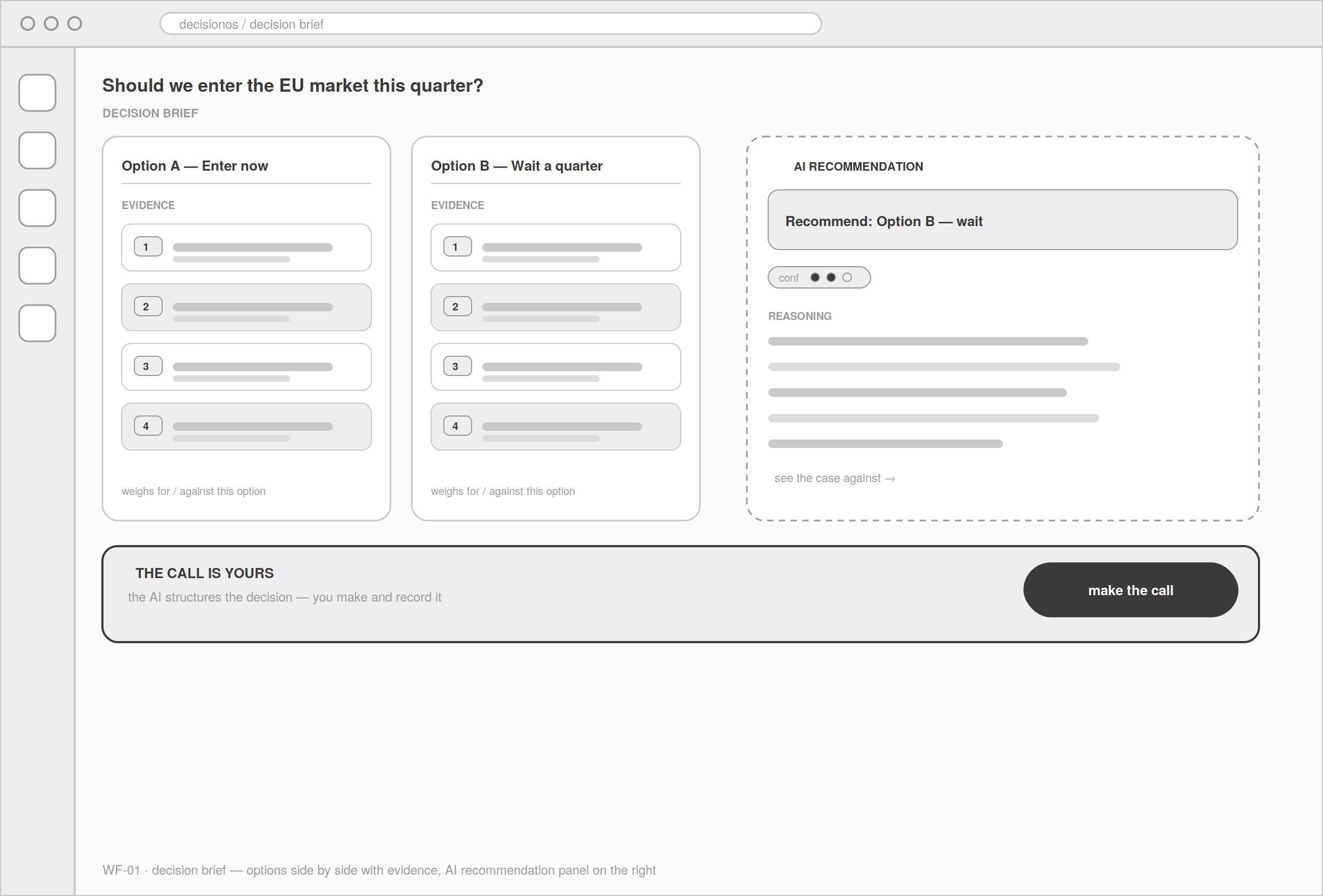
Decision brief
The signature view in greyscale: options laid side by side, evidence beneath each, recommendation panel on the right. Locked the structure of a decision before any styling.
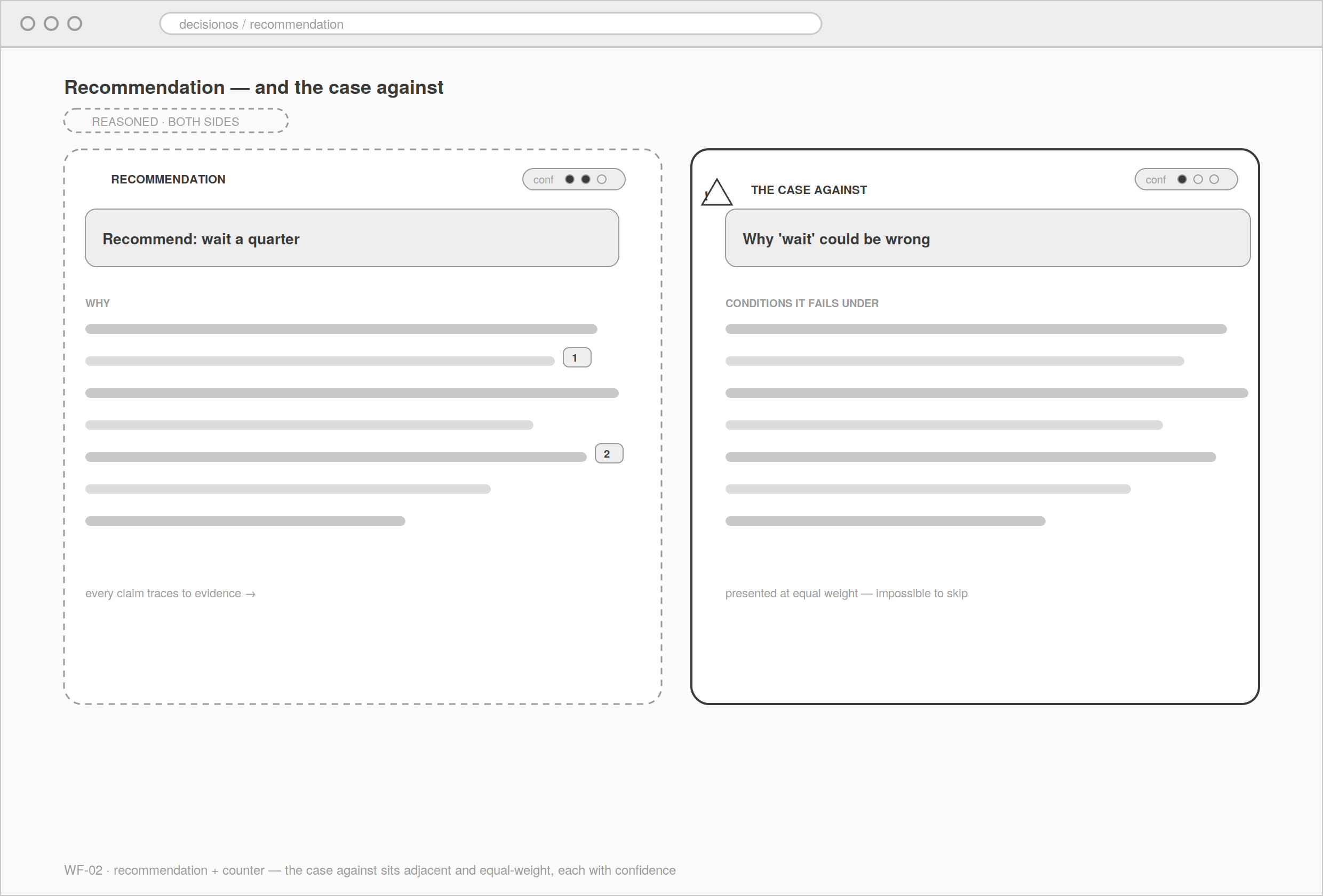
Recommendation + counter
The trust moment, structurally: the AI recommendation and its strongest counter-argument as adjacent, equal-weight panels, each with a confidence signal. Honesty by construction.
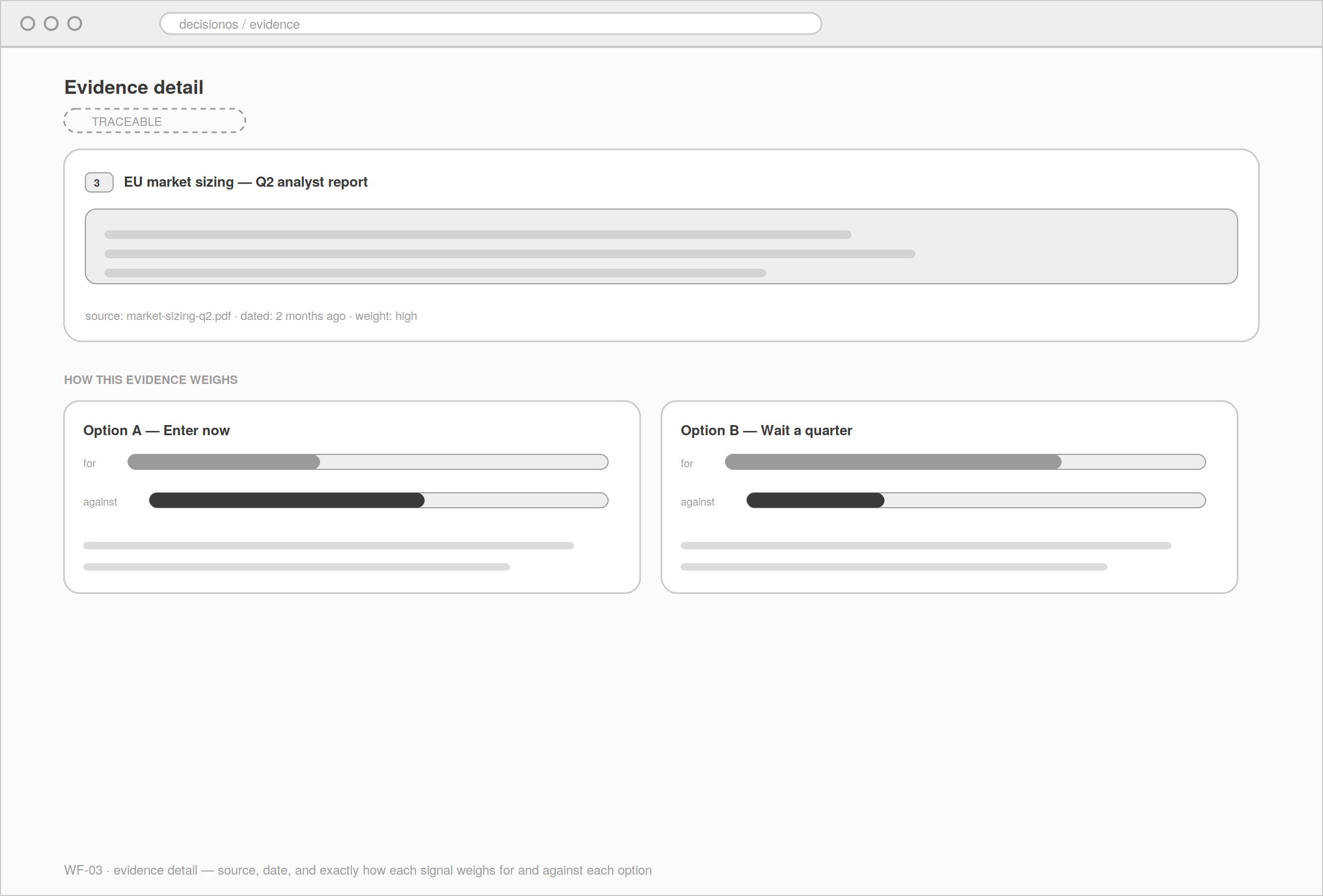
Evidence detail
Expanding a piece of evidence reveals its source, date, and how it weighs on each option. Reasoning made traceable, not asserted.
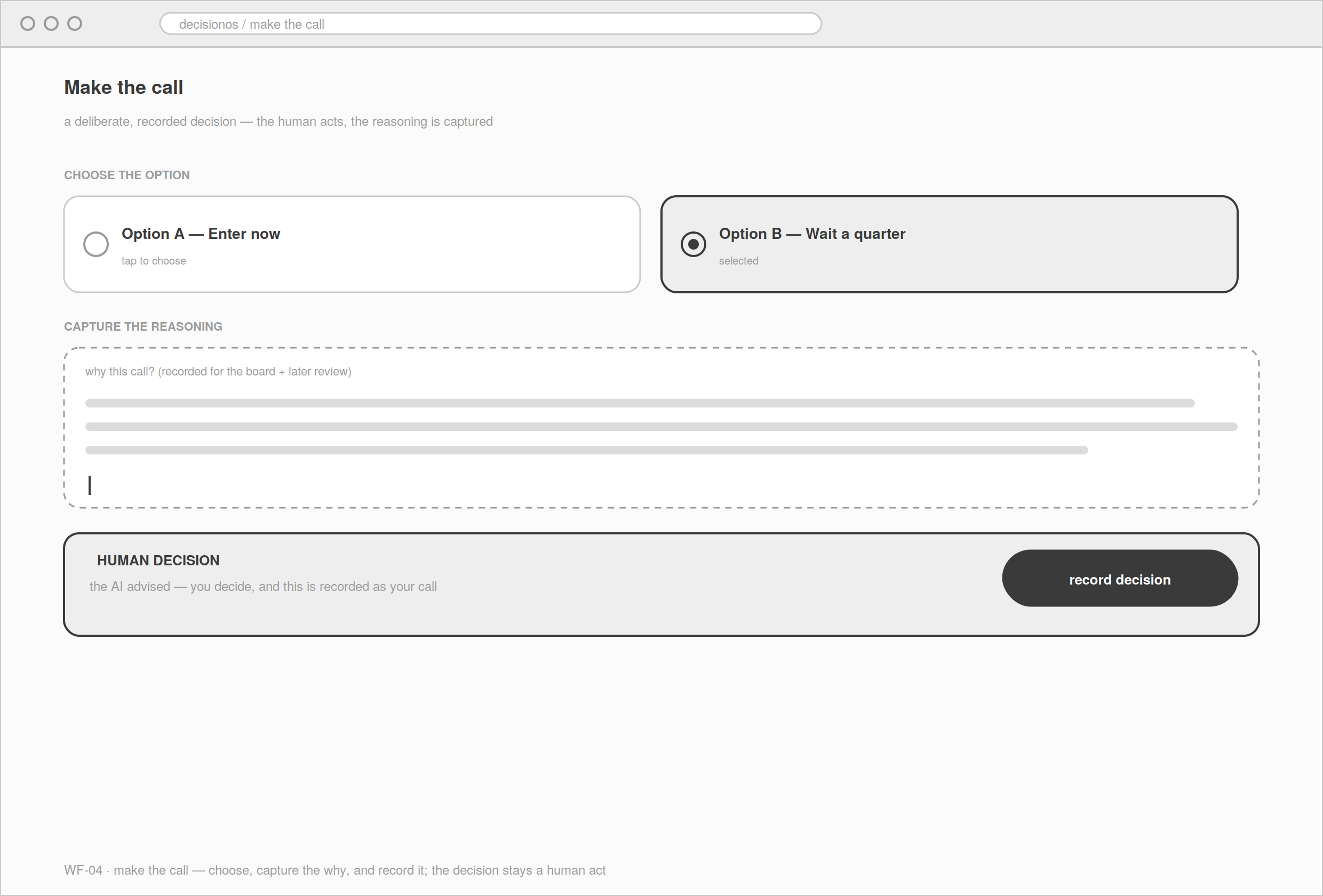
Make the call
The decision as a deliberate, recorded act: choose the option, capture the reasoning, with the human-call gate explicit. AI advises; the executive decides.
Three core task flows
Three flows carry the product, each with its AI touchpoints and human gates marked. The gates are the point: the AI structures and recommends freely, but the call itself is always a deliberate, recorded human act.
Frame → Decision brief
Question framed → signals gathered → options laid out → AI recommends with reasoning, confidence, and the case against. AI touchpoints: gathering, option synthesis, recommendation. Trust gate: reasoning and counter-case always shown.
Recommendation → Interrogate
Read recommendation → expand the reasoning → trace each claim to its evidence and date → weigh against the counter-case. AI touchpoint: reasoning generation. Trust gate: every claim traceable to evidence.
Brief → Make the call
Weigh options → choose → capture the reasoning → decision recorded for defence and review. AI touchpoint: none, this step is human. Human gate: the executive makes and records the call.
hi-fidelity design
From greyscale to a designed product. The screens below are the hi-fidelity design direction for Crux: a serious, executive-grade interface with a magenta accent reserved for the AI recommendation surface, the ✦ sparkle marking AI reasoning, and the counter-case given equal visual weight to the recommendation. These are concept screens, designed to be iterated into a build.
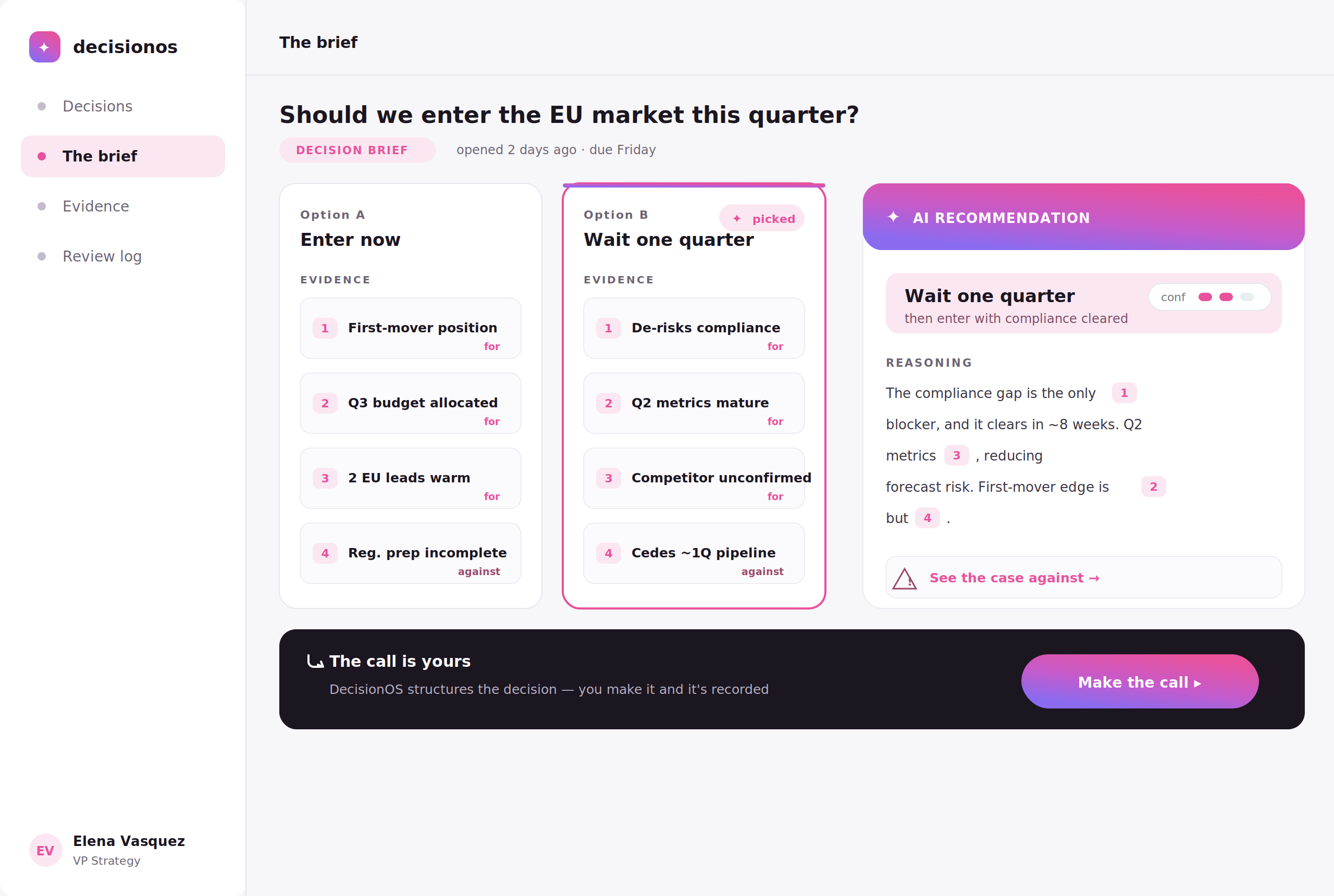
Decision brief
The hero. A consequential question, structured: options side by side with evidence, and an AI recommendation panel carrying its reasoning and a confidence signal. The deck, replaced by a decision.
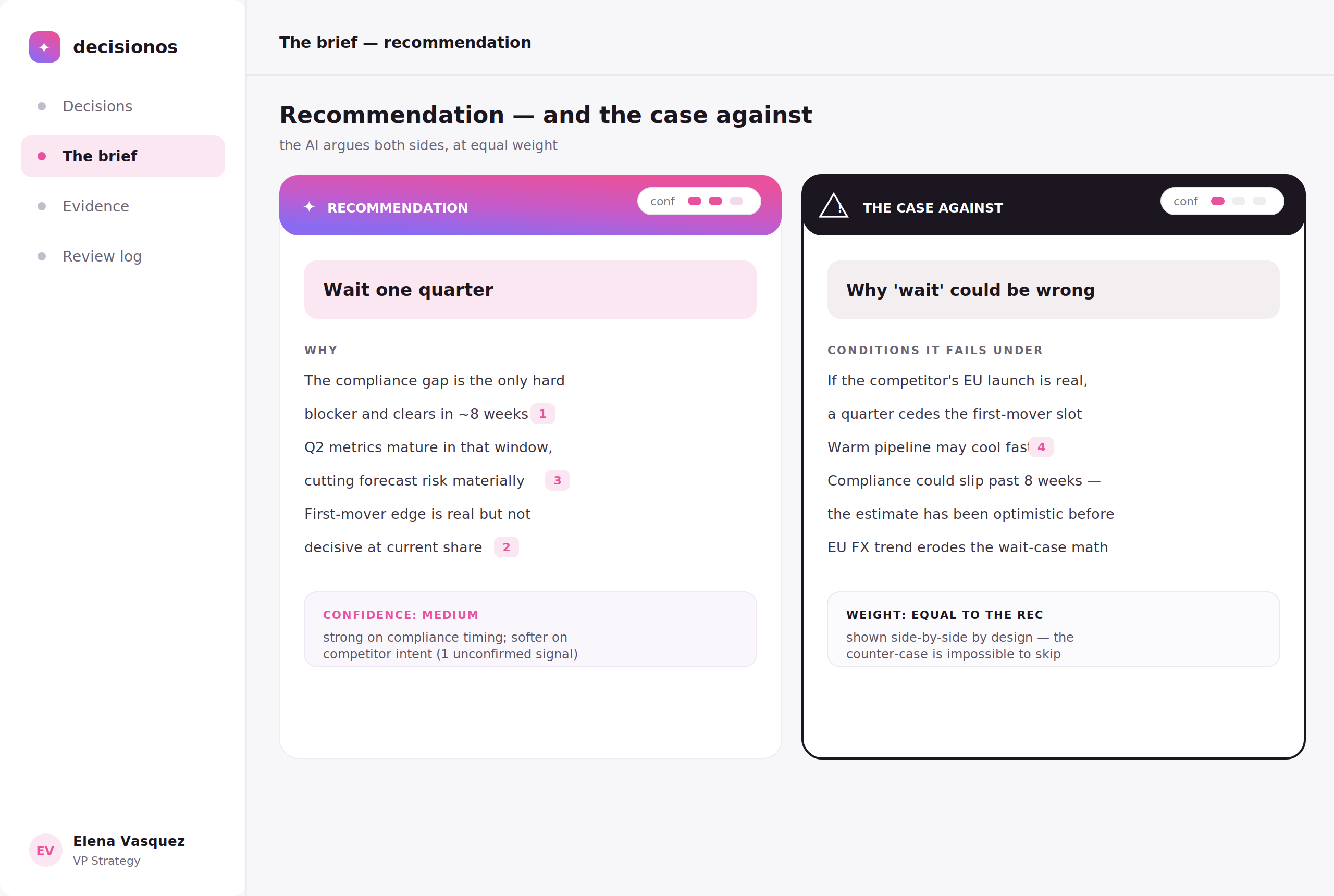
Recommendation + the case against
The recommendation and its strongest counter-argument, adjacent and equal-weight, each with confidence and traceable evidence. Honesty designed in, not bolted on.
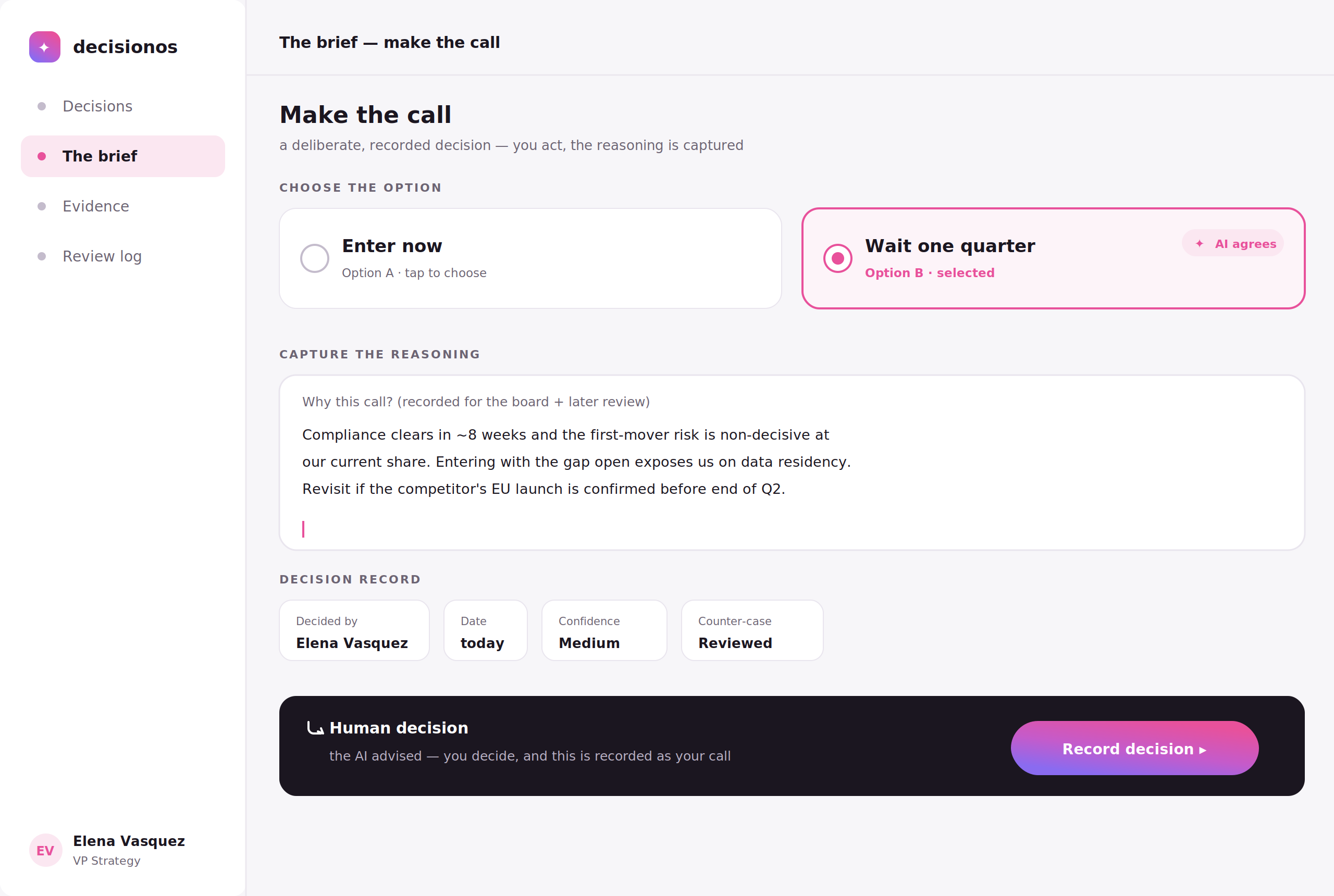
Make the call
The decision as a deliberate, recorded act: the executive chooses, captures the why, and the reasoning is preserved. Defensible to the board, reviewable later.
The AI layer: a transparent advisor, never an autopilot.
The hard part of an AI decision product isn't producing a recommendation. It's producing one a leader can trust, interrogate, and defend, without ever feeling the machine took the decision from them. Crux leans on a small set of AI-interaction patterns, applied consistently, so the AI reads as a rigorous, honest advisor rather than an oracle or an autopilot. Every pattern below appears in the design.
Reasoning + provenance
Every recommendation exposes its full reasoning chain, and every claim in it traces to the specific evidence and date behind it. No verdict without its logic.
The case against
Each recommendation carries its own strongest counter-argument and the conditions under which it fails, presented with equal weight, impossible to skip.
Confidence, honestly
A clear confidence signal on the recommendation, calibrated to evidence strength. Low-confidence calls look different from high-confidence ones.
Human makes the call
The AI structures and advises; the decision is a deliberate, recorded human act. Command stays unambiguously with the executive.
Graceful uncertainty
When the evidence is thin or conflicting, the system says so and shows the gap, rather than manufacturing false conviction.
AI design decisions
A magenta reserved for the rec
A magenta-led AI gradient and the ✦ sparkle appear only on the recommendation and reasoning surfaces, so a leader always knows what's the AI's counsel versus their own evidence and options.
Counter-case as an equal panel
The case against sits beside the recommendation at equal size and weight, never as a footnote, so honest trade-offs are structural, not decorative.
Confidence as calibrated signal
Confidence is a deliberate, evidence-calibrated signal rather than false-precision numbers, honest about how strong the call really is.
Design system.
Crux uses a serious, executive-grade foundation: confident typography, deliberate density, and a restrained dark-capable palette, so it reads as a tool for consequential calls rather than a casual dashboard. A single magenta-led gradient is reserved exclusively for the AI recommendation surface. The system shares its grid, spacing, and AI-interaction patterns with the rest of the family, taking magenta as its accent.
color foundations
typography scale
spacing scale (8pt grid)
design tokens
| Token | Value |
|---|---|
| color.surface.bg | #F7F6F9 |
| color.ink.900 | #1B1620 |
| color.brand.magenta | #E8519B |
| gradient.ai | 120deg,#E8519B,#C45BCB,#8A6BF0 |
| radius.md | 12px |
| radius.lg | 20px |
| shadow.card | 0 1px 3px rgba(27,22,32,.09) |
| icon.ai | ✦ sparkle |
component library
A Material-grade component set, extended with the AI-specific pieces that make the product trustworthy. These are the patterns that carry the confidence-and-provenance language across the OS family.
system outcomes
The system is deliberately serious so it reads as fit for consequential calls. Reserving one gradient and one icon (✦) exclusively for the recommendation surface means a leader can always separate the AI's counsel from their own evidence and options. That's a trust decision encoded directly into the tokens.
a shared OS-family base
Crux is the third of three concepts (after Slate and Almanac). It inherits the shared foundation of grid, spacing, motion, and the confidence-plus-provenance interaction patterns, and expresses it through a heavier, executive-grade magenta identity suited to high-stakes decisions.
Does it work?
I tested the hi-fi design with five leaders, executives and chiefs of staff, walking the three core flows and probing the two things that make or break an executive decision tool: do they trust the reasoning enough to act on it, and does it sharpen their call without ever feeling like it took the call away?
test setup
Participants
5 leaders
Method
Moderated hi-fi walkthrough
Tasks
3 core flows + trust probes
Focus
Reasoning, counter-case, command
key results
What the test surfaced
The case against built the trust
Every leader pointed to the equal-weight counter-argument as the thing that made the recommendation credible. An AI willing to argue against itself was, paradoxically, the one they'd trust.
Validated: keep the counter-case structural and equal-weight.
Command had to be unmistakable
Leaders were emphatic that the decision stay theirs. The deliberate, recorded 'make the call' step was what made them comfortable letting AI structure the brief at all.
Validated: keep the call an explicit, human, recorded act.
Confidence needed calibration cues
A confidence signal alone wasn't enough. Leaders wanted to know what drove it. Why is this 'high confidence'? The basis needed to be visible.
Fixed: tied the confidence signal to a visible evidence-strength rationale.
The numbers & what this proves.
Concept work. Figures below are design targets and test outcomes, framed as such, not shipped production metrics.
What this concept demonstrates
Designing AI for the highest stakes
Reasoning transparency, an equal-weight counter-case, calibrated confidence, and human command. The concrete moves that make AI trustworthy where the stakes are highest.
Reframing data as decisions
A decision-centric IA, validated by a card sort, that treats data as evidence for a call rather than the thing you stare at.
End-to-end ownership
From decision-reconstruction interviews to a verified hi-fi design. The full arc, with defensibility designed in from the first principle.
Completing the family
Built on the shared foundation, proving the system spans recruitment, knowledge, and decisions while staying coherent.
artifacts created
Hi-fidelity design
The decision brief, the recommendation-plus-counter-case surface, and the make-the-call step. The designed product, ready to iterate into a build.
Research synthesis
Decision-reconstruction findings, the anatomy-of-a-decision map, affinity themes, decision-flow map, and competitive teardown.
IA & flows
Card-sort-validated, decision-centric information architecture and three core flows with AI touchpoints and human gates marked.
AI-native design system
An executive-grade foundation with a magenta AI-reserved gradient, recommendation and counter-case panels, and calibrated confidence signals.
where it goes next
- →An interactive prototype of the decision brief, to test the recommendation-and-counter-case interaction live
- →A decision-quality study tracking whether structured briefs produce measurably more defensible calls
- →Bringing the family together: shared sign-in, shared memory, one coherent AI-native suite across Slate, Almanac, and Crux
key learnings & reflection
what went well
- Reconstructing real decisions (not theorising about good ones) surfaced defensibility, not data access, as the true problem, which reframed the entire product
- Giving the counter-case equal visual weight to the recommendation was the single highest-leverage trust decision, and every leader named it
- Making the call a deliberate, recorded human act resolved the deepest tension, letting AI structure the decision without ever seeming to take it
- The decision-centric IA held up under the card sort. Leaders genuinely think in calls, not dashboards
what I'd do differently
- Would test with a live, consequential decision rather than a reconstructed one. Real stakes change how people weigh a recommendation
- Should have designed the conflicting-evidence state in more depth. It's the hardest and most valuable moment in a real decision
- Would prototype the confidence-calibration rationale earlier. The signal alone under-delivered until its basis was visible
- Would involve a board member in research. The defence audience shaped the product but was studied only second-hand
more concepts
the rest of the OS family →
thank you for reading.
Crux is a self-initiated concept. If you'd like to talk through the process, or where it goes next, I'd love to connect.