AI-native concept · self-initiated
Slate
An AI recruiting workspace for staffing agencies. The system finds candidates, ranks them and drafts the outreach, and the recruiter decides who actually gets contacted. I designed it from the desk research through to a working prototype you can click through. Trust is the thing it is built around, so every score shows how confident it is and where it came from.
The problem, in published industry numbers. Sources in Where It Stands.
What I owned
Concept · self-initiated · not client work
I organised the whole workspace around the engagement rather than around the tools, because that is how recruiters think about their work.
Recruiters lose 40%+ of their time to non-recruiting admin (Aqore, 2026), juggling an ATS, LinkedIn, job boards, and spreadsheets. Slate rebuilds the desk around the engagement, with an AI copilot that sources, ranks, and drafts, but never sends. The recruiter decides, and every suggestion shows its confidence and its source. Designed end to end and built as a working prototype.
This is aimed at staffing agencies rather than HR departments. Everything is organised around the engagement, and the recruiter gets an AI copilot that finds candidates, ranks them, drafts messages and writes the updates. The recruiter still decides anything that matters. I deliberately did not build an HRIS, a job board, or an ATS with a chatbot stapled on.
what it is
- A project-centric workspace where every engagement is a project
- An AI copilot that does the admin and flags the candidates worth a look
- A system that earns trust by showing confidence + provenance
what it is not
- Not an HRIS / payroll / compliance suite
- Not a job board competing with Indeed
- Not an ATS with an AI chatbot bolted on
Slate exists as a working, clickable product. The screens below are captured from the live prototype: Google / Material-3 design language, a Gemini-style gradient reserved exclusively for AI surfaces, and the ✦ sparkle marking every AI action. It's the real prototype, not a screen mock-up: you can open it and click through. It shows the intent without claiming results.
a few key screens
The prototype above is the real thing; these are highlights.
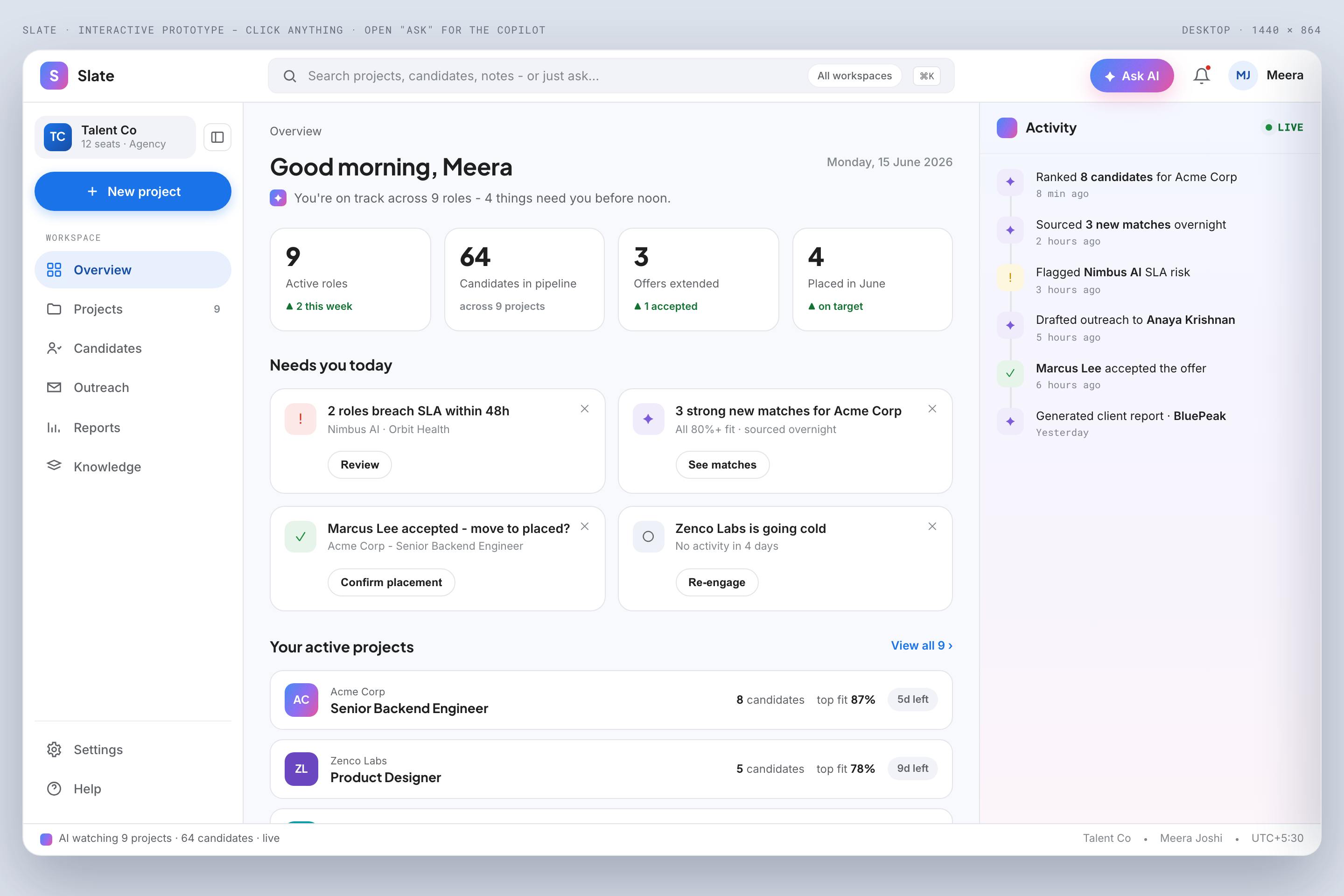
Overview
The whole agency on one screen: active projects, how the pipeline is doing, and what the copilot thinks needs attention today. This sits above the individual project workspaces.
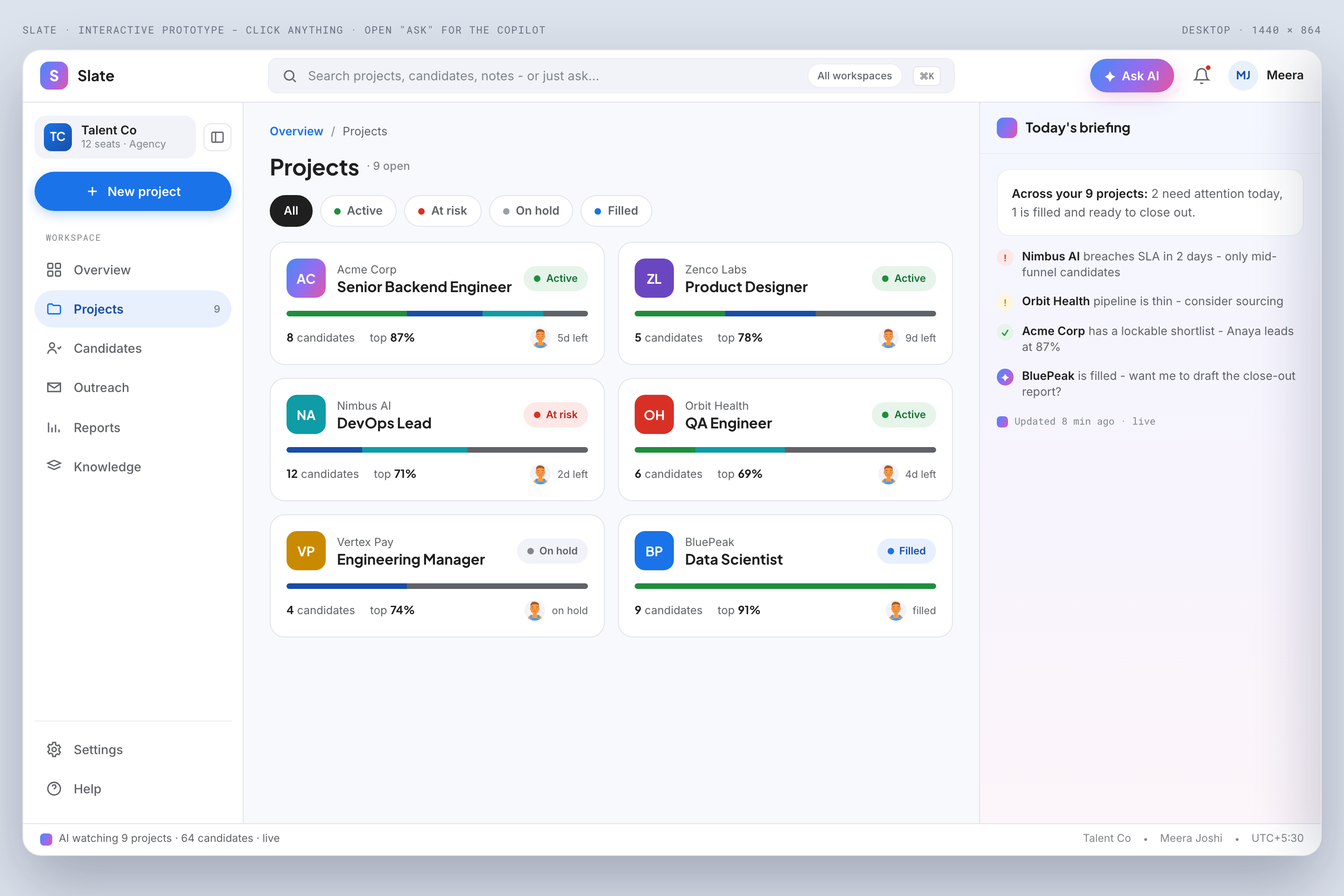
Projects
Every engagement is a project, and this list is the home of the product. Status, client and candidate counts, all in one place.
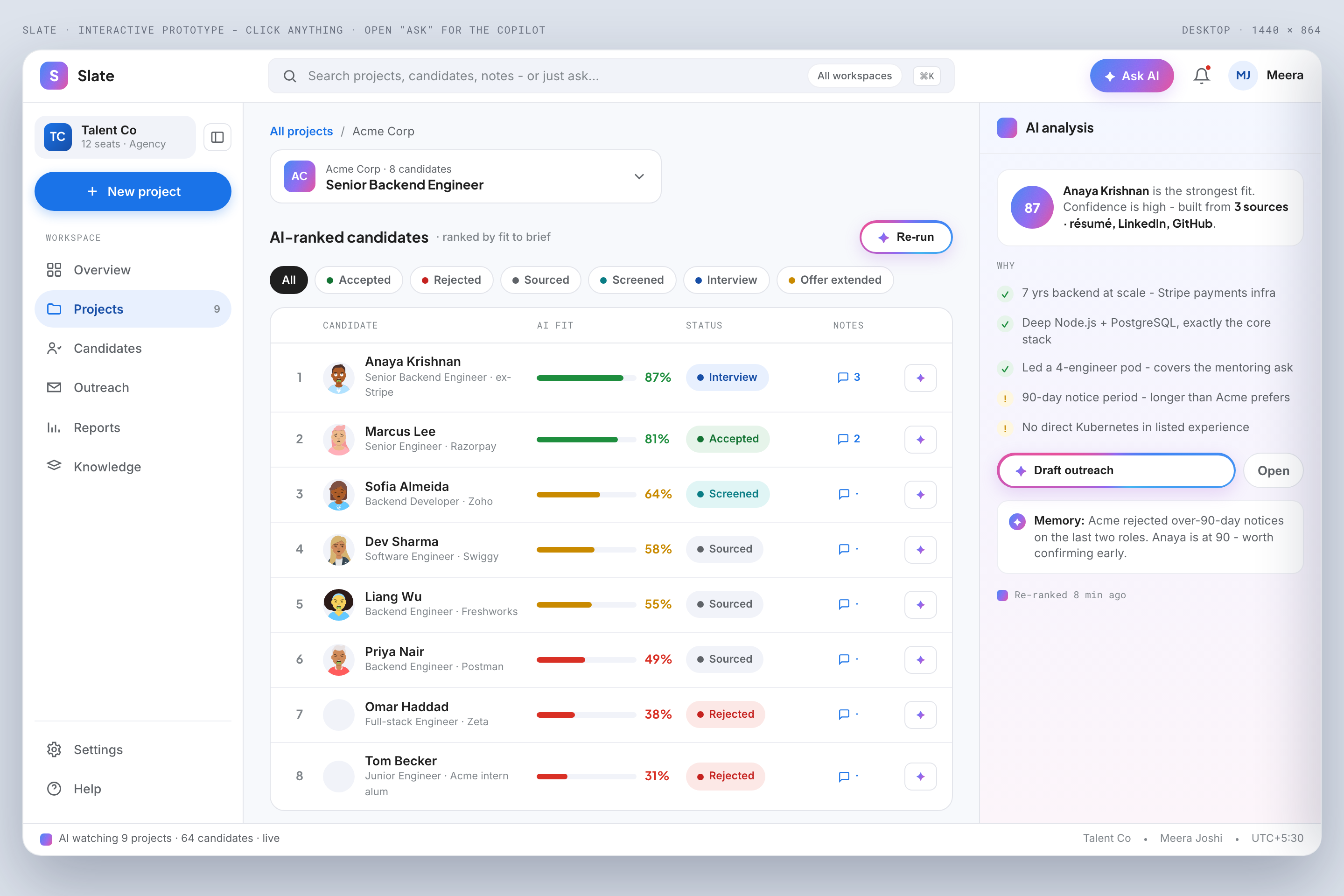
Project workspace
The main view. The ranked candidate table is on the left and the AI copilot is docked in the right rail, so help is always there without being a separate mode you have to switch into.
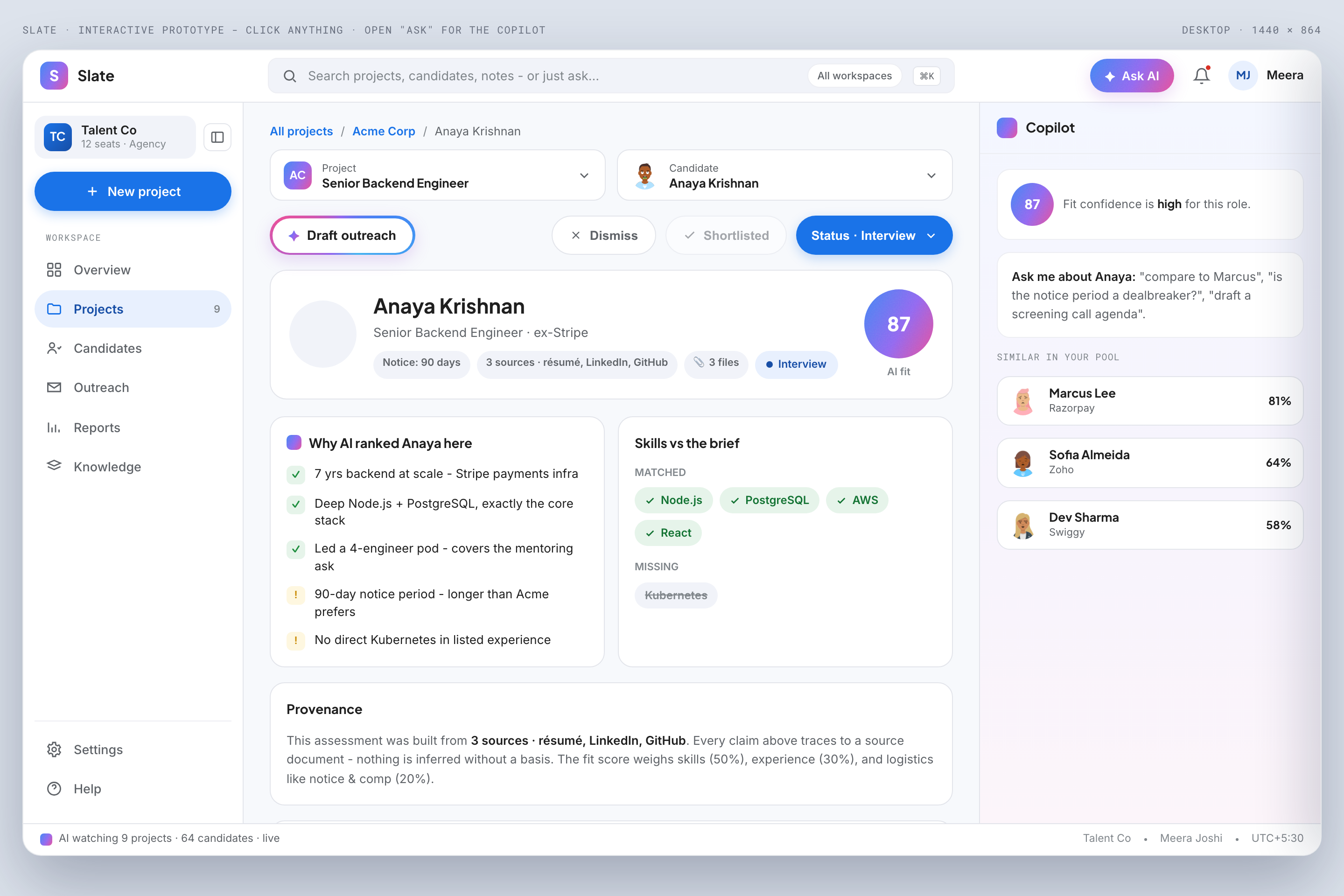
AI candidate analysis
This is where the trust work shows. The fit score, the skills and the red flags each carry a confidence level and the source behind them, so you can see exactly why the AI said what it said.
Candidate detail
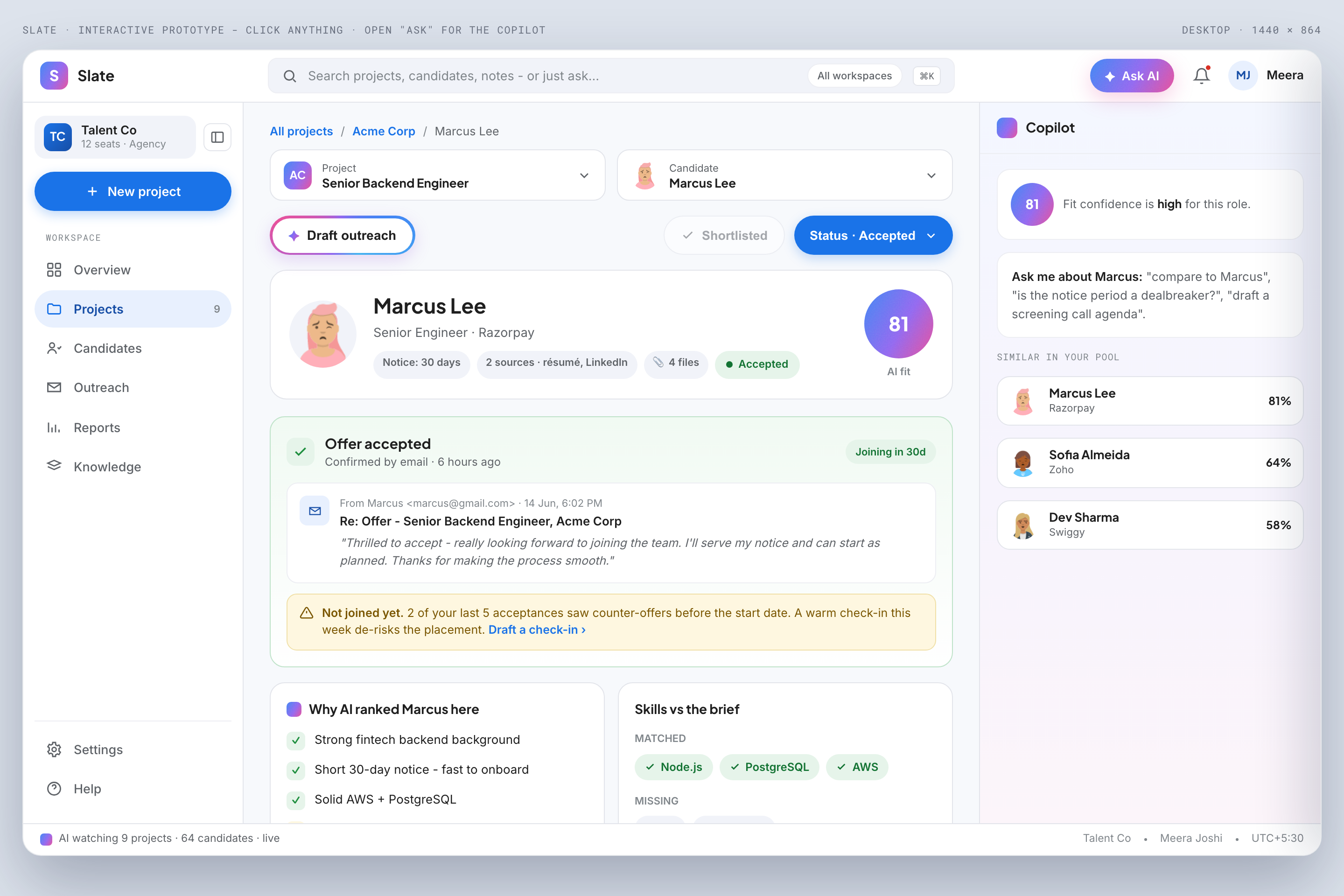
The full profile, built from a CV or a pasted profile. The AI summary sits at the top with the evidence underneath it, and every claim traces back to a source.
Shortlist & compare
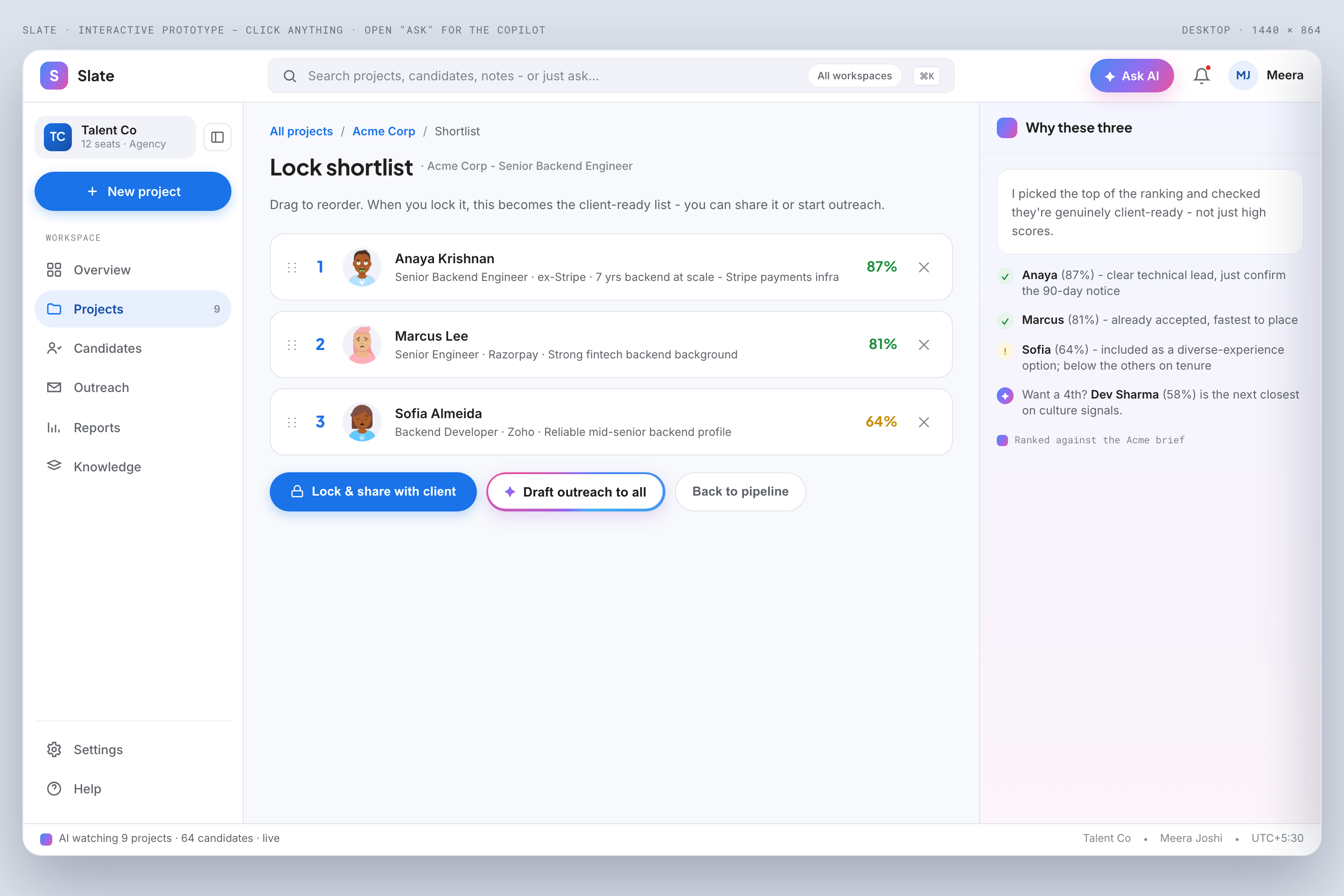
You turn the AI ranking into a shortlist and compare candidates next to each other. Recruiters already do this comparison in their heads, so this just puts it on the screen.
AI outreach composer
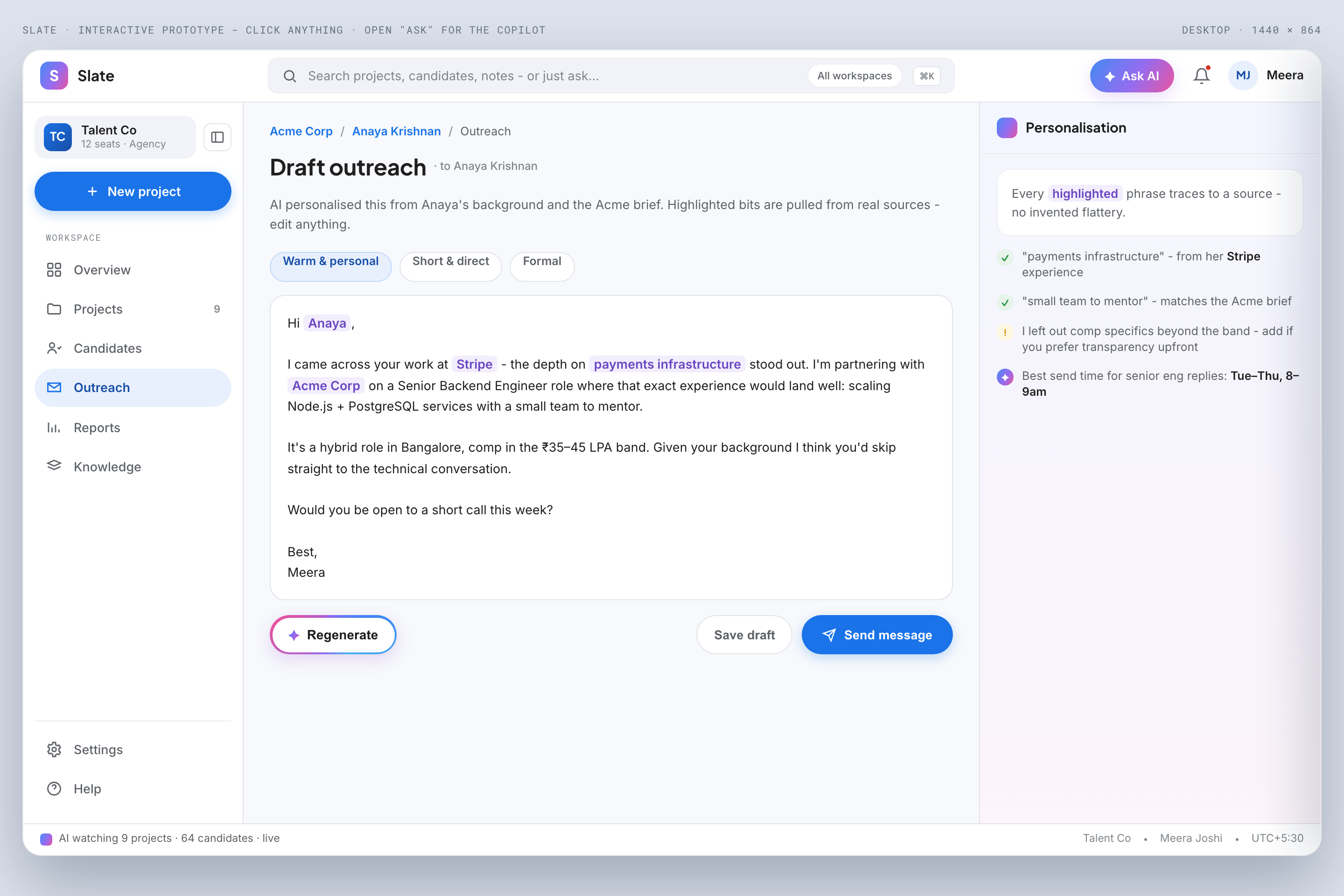
The AI drafts a personalised message and the recruiter edits it and sends it. Nothing goes out without somebody reading it first.
Client report
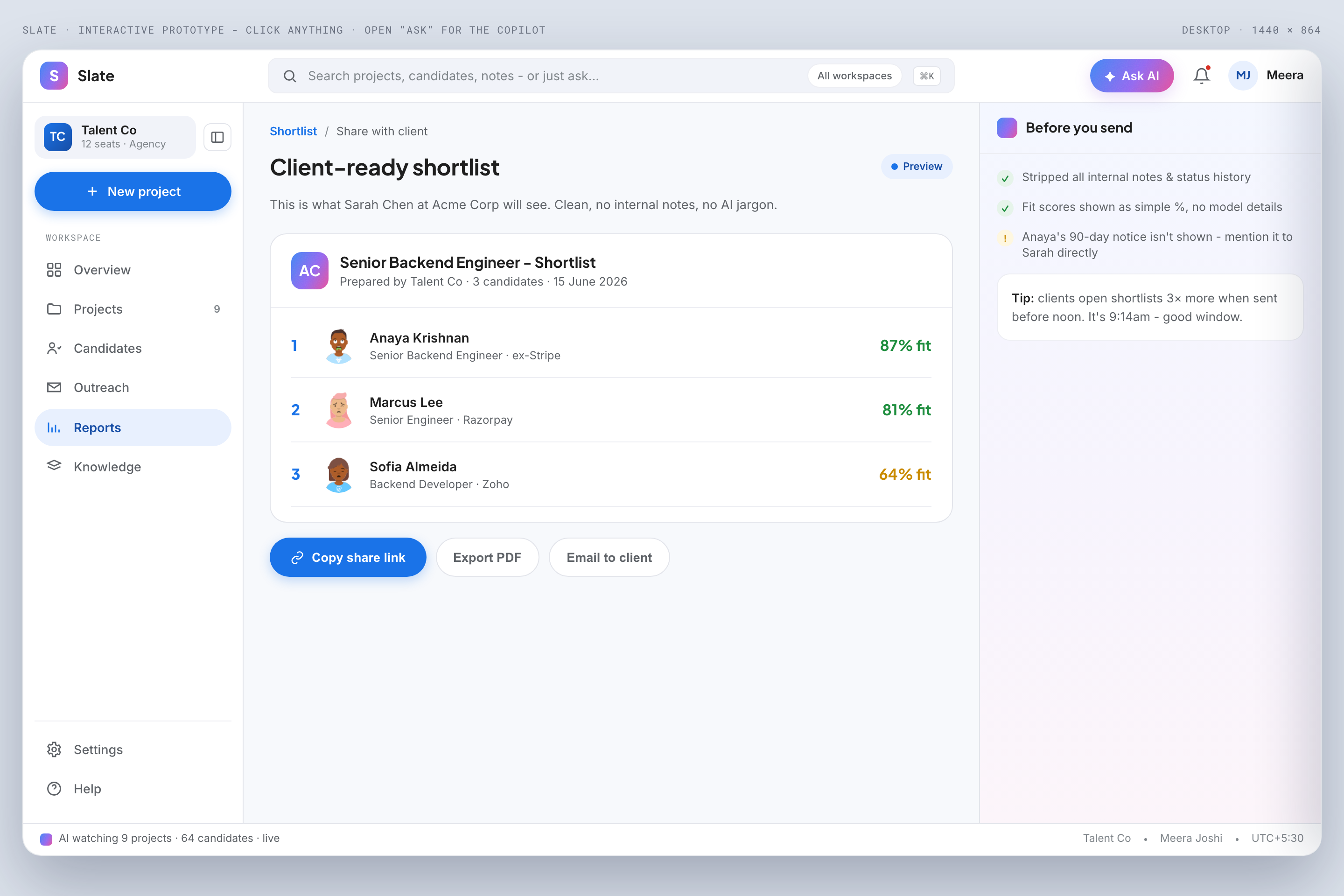
A client-ready status update generated from the state of the project, which the recruiter reviews before it goes out. It replaces the scramble that usually happens on a Friday afternoon.
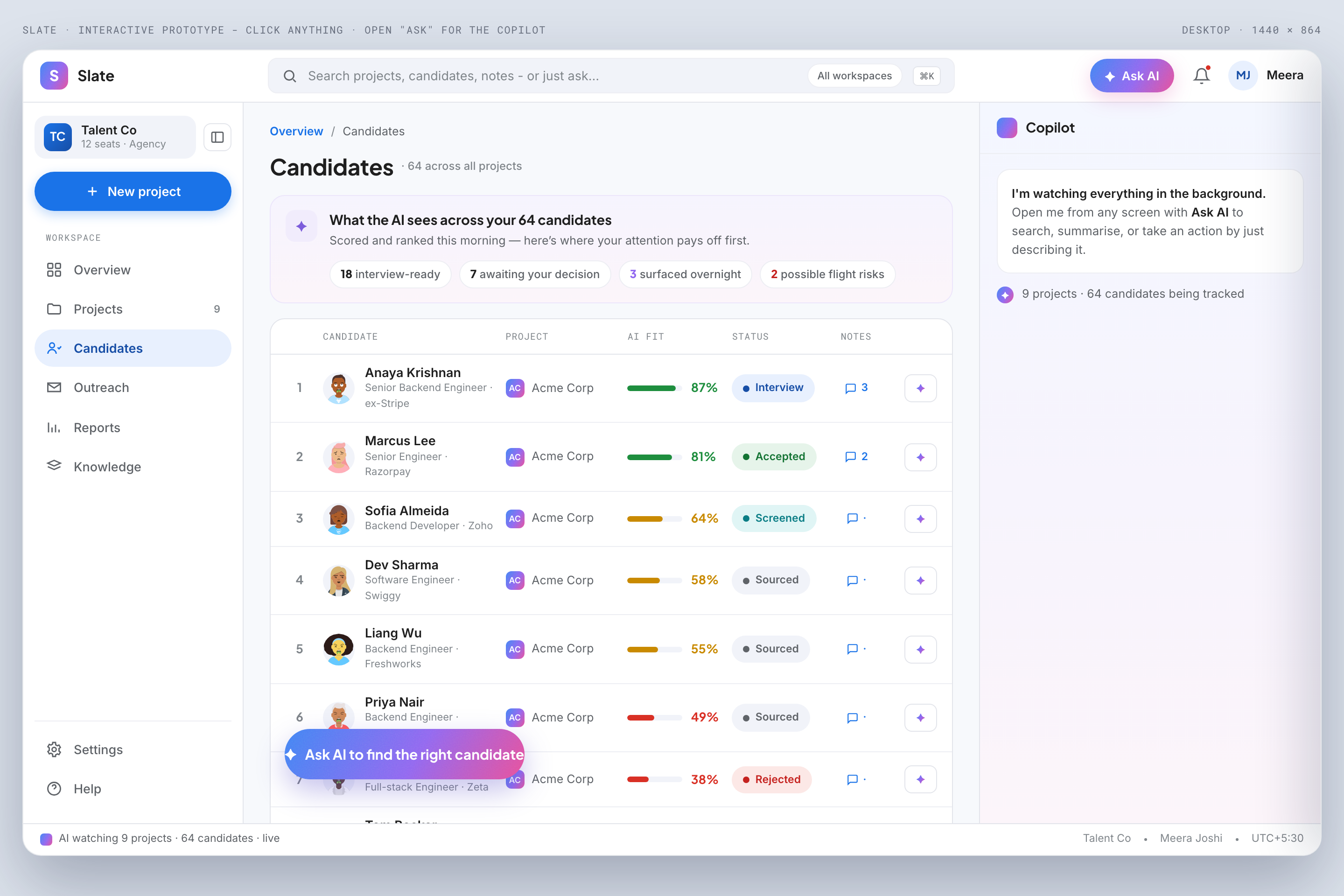
Candidates (cross-project)
The same ranked-table component, reused across the desk. One consistent way to read rank, fit, status, and notes everywhere it appears.
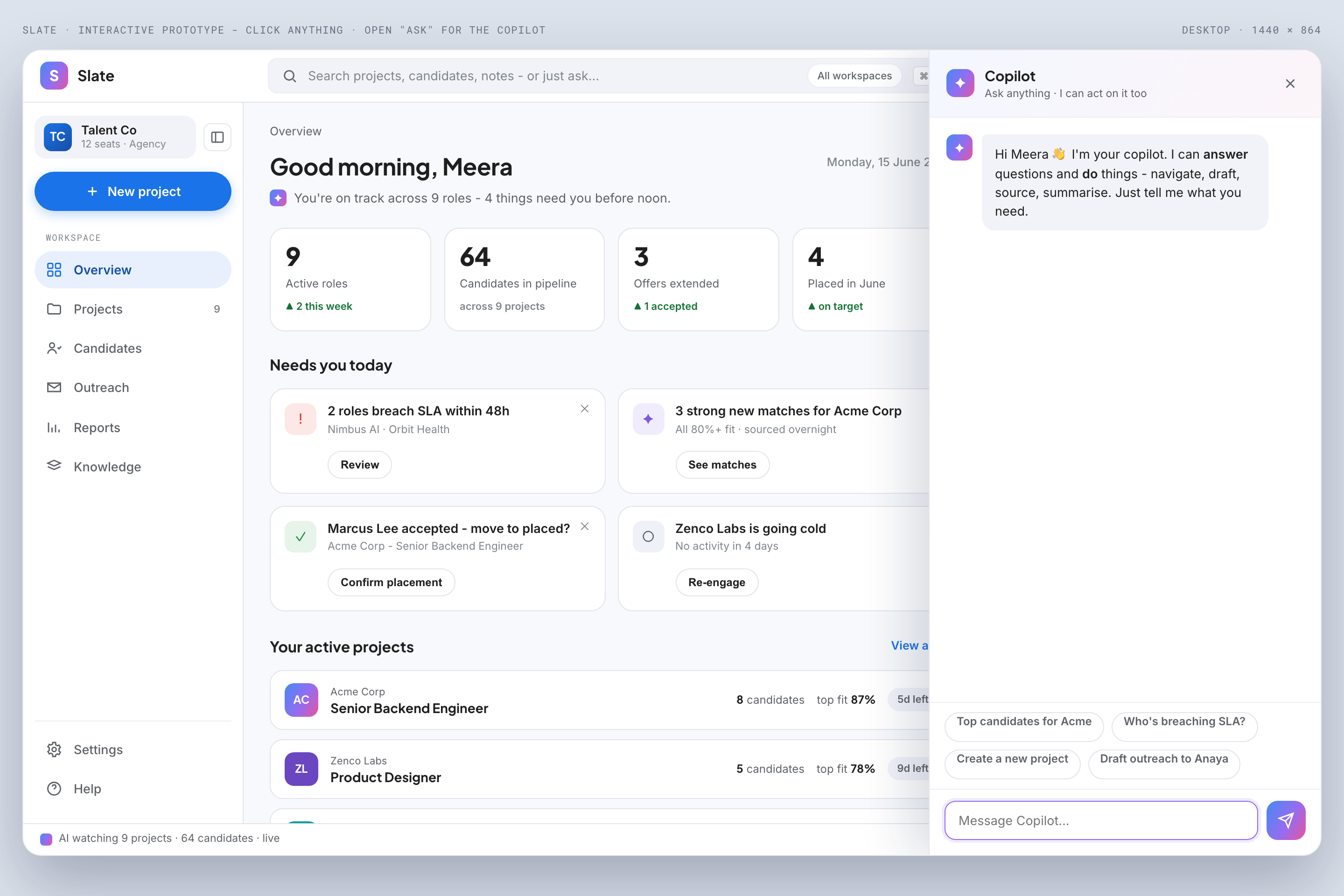
Ask-AI copilot
Natural-language search and actions across the whole desk. Ask in plain English, get an answer grounded in your projects, candidates, and notes.
Recruiters have been burned by 'AI matching', so I made this AI show its work.
Black-box scores surface the wrong people with total confidence. So I designed the AI to earn its keep differently: it shows its work, and it never has the last word. I leaned on a small set of interaction patterns, applied consistently, so it reads as a transparent colleague, not an oracle. Every pattern below is in the prototype.
Confidence + provenance
Every AI output, whether a fit score, summary, or red flag, carries a confidence level and a clickable trail to the source it came from. The single most important trust move in the product.
Human in the loop
Consequential actions (send outreach, advance a candidate, share a report) are always gated behind a person. The AI proposes; the recruiter approves.
Progressive disclosure
AI reasoning starts collapsed and expands on demand. A glanceable answer for the fast path, the full 'why' one click away for when it matters.
Editable AI output
Nothing the AI writes is final. Drafts and summaries are starting points the recruiter shapes, keeping the human voice and judgement in the loop.
Graceful uncertainty
When the AI isn't sure, it says so: low-confidence states, 'not enough signal' messages, and honest gaps where a guess would be easier.
I'm separating what I proved from what I still have to test.
Nothing here is claimed as measured. These are the targets the design is built to hit, and they'll be tested, not asserted.
What's done
- A researched, defined problem, built from public time-studies, recruiting communities and tool reviews.
- A competitive teardown anyone can verify: ecosystem map, heuristic evaluation, and a capability scorecard.
- An end-to-end design: IA, three core task flows, wireframes, and a full AI-native design system.
- A working, clickable prototype of the core loop, the proof the design holds together as an experience.
What I'm designing toward
Reclaim the admin time
The research says ~17 hrs/week per recruiter is reclaimable with AI (Bullhorn). The target is to win back a meaningful slice of that, to be measured with real recruiters, not assumed.
Trust the AI enough to use it
The success signal isn't a score; it's whether a recruiter acts on an AI suggestion after checking its provenance. That's a usability question, and the first thing I'd test.
Nothing lost when someone leaves
Whether organisational memory actually survives a departure is a longitudinal question, one for a pilot, not a prototype.
This is a self-initiated concept, and I am still building it. What is above is honest about what is proven and what is not.
thank you for reading.
Slate is a self-initiated concept I keep iterating on. If you'd like to talk through the thinking, or where it goes next, I'd love to connect.